The siege of Namur between 2 July and 4 September in 1695 (or the second siege of Namur) took place almost at the end of the Nine Years’ War. It had been captured by the French in the 1693 siege and its recapture by the Grand Alliance in 1695 are often viewed as the defining events of the war; the second siege is considered to be William III’s most significant military success during the war.
The 1690s marked the lowest point of the Little Ice Age, a period of cold and wet weather affecting Europe in the second half of the 17th century. Spain and Scotland in particular experienced famine; the harvest failed in 1695, 1696, 1698 and 1699 and an estimated 5–15 per cent of the population starved to death.
On 2 July the Earl of Athlone had unexpectedly surrounded Namur with the cavalry. Although this was a surprise to the French, General Boufflers had a garrison of 13,000-16,000 men, making a siege a formidable challenge. After Athlone’s action, the circumvallation line was soon completed. When the artillery equipment arrived, on 12 June, the Brandenburgers, from across the Meuse River, opened artillery fire on the City; the next day, the Dutch started it on the St Nicolas Gate side, On July 18 the French launched an assault on the position of Brandenburg’s General-Field Marshal Heino Graf von Fleming, the Dutch under Major General Ernst von Salich captured three detached bastions and forts outside the St Nicholas Gate and, with sword in hand, drove the French into the city itself. The losses on both sides were heavy.
On 27 June, William III personally led a successful attack of 400 Dutch and English grenadiers on the counterscarp. At the same time, the Maximilian of Bavaria took possession of an abbey, from which he forced over 300 dragoons into the Citadel. After the capture of the line Vauban had built between the Meuse and Sambre rivers in the rocks, and further Allied successes, the French decided to surrender the city. After 4 August only the Citadel was still in French hands. Half the French garrison had been lost. Count Guiscard, the Governor of Namur, asked for a truce to allow the French to withdraw to the Citadel, which was accepted and the siege resumed after six days. A siege of the Citadel could not be proceeded with immediately due to a lack of money to pay the workers.
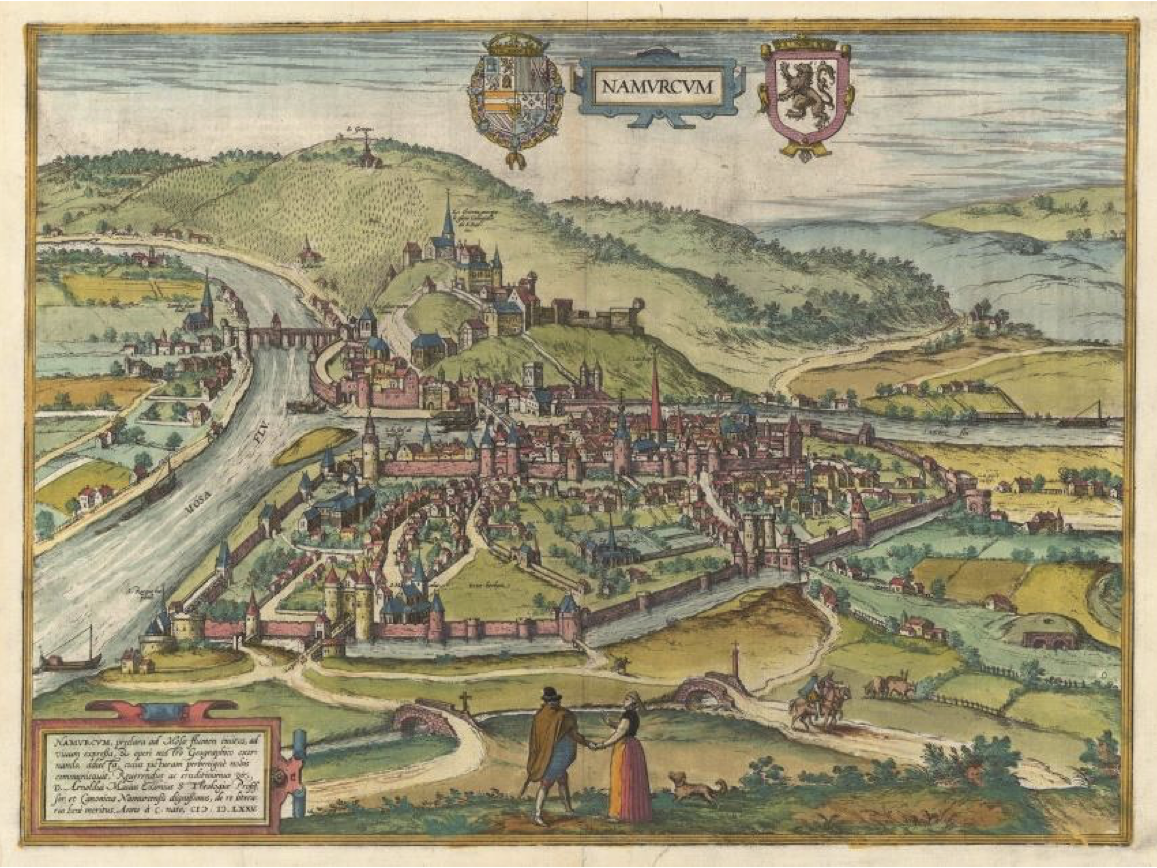
Siege of Namur
Vaudémont’s role was to keep his field army between Villeroi and Namur, while Villeroi tried to tempt him out of position by attacking Allied-held towns like Knockke and Beselare now Zonnebeke. Vaudémont refused to be drawn since both sides knew the longer the siege went on, the more likely Namur was to fall. Villeroi’s attempts to out-manoeuvre Vaudémont were unsuccessful, despite the capture of Diksmunde and Deinze in late July with 6,000–7,000 prisoners. The Bombardment of Brussels between 13–15 August also failed to divert the Allies, despite destroying large parts of the commercial centre.
By mid-August, the Citadel was largely intact, Villeroi was making resupply much more difficult, while the besiegers were beginning to lose men to disease, in an age when far more soldiers died from illness than in battle. The Allies were running out of time and Coehoorn and William now agreed a new approach; a battery of 200 guns was established in Namur city and on 21 August began a continuous 24-hour bombardment of the Citadel’s lower defences. Boufflers later told Louis it was ‘the most prodigious artillery ever assembled’ and by 26 August the Allies were ready to assault the Citadel. At midnight on 27th, Villeroi finally made contact with William but his numerical advantage of 105,000 to 85,000 was offset by the strongly entrenched Allied positions. Having failed to outflank the Allied lines, Villeroi retreated and William gave the order for a general assault.
The assaults by the Allies were extremely bloody, that of 30 August alone costing 3,000 men in less than three hours but the defenders were eventually forced back to their final lines of defence. Count Guiscard, now commanding the key outwork of Fort Orange, told Boufflers on 2 September they could not repulse another attack and the garrison surrendered on 4 September, having suffered 8,000 casualties to the Allies’ 18,000.
The two sieges of Namur were a huge media spectacle. There are few examples in early modern history where the media commented so extensively, so diversely on military events. In the Dutch Republic, France and England many eulogies, illustrations, maps and medals related to the sieges were produced and newspapers wrote about the events in great detail. Although much of this was done on the publicists’ initiative, it was also encouraged by the state. This way, the governments hoped that the public remained engaged and convinced of the war effort and that it would make their allies more confident, while reducing the enemy’s morale. William and Louis also saw all the publicity as an opportunity to enhance their reputation. The assault by 3,000 British troops on the Terra Nova earthwork on 31 August spearheaded by 700 grenadiers is alleged to have been the inspiration for the song “The British Grenadiers”.
Extract from Wikipedia.