The Coldstream Regiment of Foot Guards evolved from Monck’s Regiment, which in turn was recruited from the New Model Army.
Monck’s Regiment of Foot
Formed on 13 August 1650, by Colonel George Monck from five companies each from Sir Arthur Hesilrige’s and Colonel George Fenwick’s regiments. The formation was initiated by Oliver Cromwell, who had been impressed by Monck’s military leadership in Ireland. Originally named Monck’s Regiment of Foot, it was created to help secure the Scottish border. The regiment saw action at the Battle of Dunbar (3 Sep 1650) and was one of the few Cromwellian units retained by Charles II.
The March: Under Monck, the regiment was stationed in Coldstream on the Scottish border for three weeks in late 1659 before marching with 7000 other troops to London on 1st January 1660 to restore the monarchy.
Renaming: Following the Restoration of Charles II in 1660, the Convention Parliament decided to disband all the remaining units of the New Model Army. However Monck’s regiment was formally disbanded and then immediately reconstituted as The Lord General’s Regiment of Foot Guards in February 1661. General Monck died in 1670 and command passed to the Earl of Craven. Officially the regiment was the Second Foot Guards, but this was never accepted by the Guards and they adopted the name ‘The Coldstream Regiment of Foot Guards’. Known for their motto “Nulli Secundus” (Second to None), they have served the Crown since 1660 and were formally designated as the Coldstream Guards in 1855.
The Coldstream Regiment of Foot Guards (2nd Foot Guards)
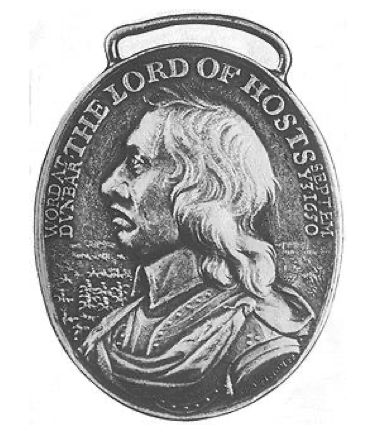 In 1650 Scotland still held great sympathy for the Royalist cause. The Scottish1After the execution of Charles I at Whitehall on 30 January 1649, the Covenanter Parliament of Scotland proclaimed Charles II king on 5 February 1649. had declared Charles II King and Charles seized the offer of a Scottish army to help reclaim the throne of England. On hearing this news, Oliver Cromwell, now back from Ireland, marched north, and decisively defeated Charles’s army at the Battle of Dunbar on 3 September 1650. Monck’s Regiment of Foot took part in the battle under Cromwell. Afterwards, Cromwell ordered a special medal to be struck and awarded to the officers and men of the New Model Army (the Dunbar medal – see picture). The Coldstream Guards are the only surviving Regiment to have earned this early example of a campaign medal. Monck was appointed military commander in Scotland in 1651-1652 and then again in 1654 to 1660 with a gap for a serious illness.
During the civil and military unrest that followed the resignation of Richard Cromwell, Monck, as General Commanding in Scotland, was concerned that the nation would descend into anarchy. He led his army from Coldstream taking five weeks to reach the capital on 3rd February 1660. Despite some opposition to his ideas, Monck managed to break the army’s domination of the Government and brought about the election of a freely-chosen parliament, which met on 25th April 1660. One of the first acts of this new ‘Convention’ Parliament was to vote for the return of the Monarchy.
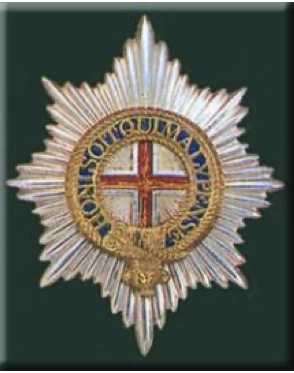 On 25 May 1660, the King landed at Dover, where General Monck welcomed him. During the journey to London, the King showed his gratitude to General Monck by bestowing on him the Order of the Garter, which is now the basis of the Regimental cap star – see picture. He was also created Duke of Albermarle. On 26 August 1660, Parliament passed an act ordering the disbandment of the entire New Model Army. No exceptions, including General Monck’s regiments, were allowed, although one concession was made: they should be the last to disappear. This concession had far reaching effects. On Sunday, 6 January 1661, two days before Monck’s regiments were to be disbanded, an armed revolt occurred led by Thomas Venner. His followers called themselves the Fifth Monarchy Men and were causing trouble in the city. The King’s Regiment of Guards led by John Russell were unable to cope with the situation so forcing an alarmed Parliament to call on the Lord General’s Regiment to restore order. Monck’s men, veterans of a decade of hard campaigning, swiftly quelled the rebels and ended the rioting. A grateful Parliament repealed the order for disbandment. On 14 February 1661, Monck’s Regiment of Foot paraded at Tower Hill. The men symbolically laid down their arms and with them their association with the New Model Army. They were immediately ordered to take them up again as Royal troops in the New Standing Army.
The regiment provided 500 men as marines at the beginning of 1664 and these fought in an engagement off Harwich against the Dutch. The Commander of the force was the Duke of York. In the same year the regiment provided a detachment that captured New Amsterdam from the Dutch in 1664. This was led by Captain Robert Holmes who was both a Royal Navy captain and a Coldstream Guards captain. This was not so unusual at the time, General Monck himself won several naval battles, famously ordering the fleet to ‘Charge!’ After the capture of New Amsterdam it was named New York after the Duke of York.
The regiment also provided detachments that fought as marines during the Second Anglo-Dutch War 1665-1667 while their Colonel was in a shared command of the fleet. He had been a General at Sea during the First Anglo-Dutch War under the Protectorate. Monck and Prince Rupert shared command during the 1666 campaign; the Four Days’ Battle in June was a Dutch victory, offset by English success at the St James’s day Battle in July. In September he was recalled to help maintain order in the chaos created by the Great Fire of London. Monck died in 1670 and was buried in Westminster Abbey.
In 1678, the Regiment served in Flanders where the new army was constantly developing. Pikemen had ceased to wear a waist scarf by 1677. The Guards Regiments were ordered to form Grenadier Companies, these men were the strongest and tallest of the regiment, they carried axes, hatches and grenades, and were assault troops. They carried short muskets (3 feet 2 inches) equipped with a sling. Grenadier was an experimental battlefield role at this time, rather than a Regimental title. One special feature of their uniform was a tall mitre hat decorated with fur, which was common to grenadiers in European armies. The regiment returned to England the following year at which time it consisted of twelve companies each officially numbering 100 men. From 1685 the companies were reduced in strength to 80.
A detachment of two officers and 130 other ranks of the Regiment landed about the 20th July 1680, at Tangier as part of a Composite Guards Battalion. Fierce attacks were made against the Moors, who had obtained a footing on the outworks of the town, finally defeating them by controlled and well-aimed musket fire, gaining its first battle honour. The Battalion remained in Tangier until it was abandoned for political reasons in 1684. After returning to full strength in 1685, the Regiment helped to suppress the revolt of the Duke of Monmouth and fought at Sedgemoor 1685 with the other two Guards Regiments. In 1686, plug bayonets were issued for the first time to the regiment and pikemen were no longer in service. The introduction of snaphaunce muskets was slow, starting from 1667 and not complete in the Coldstream Guards until 1684.
The regiment remained loyal to James II and so was distrusted by William III following the Glorious Revolution. He sent it to Flanders under the command of former First Guards officer, John Churchill, by now The Duke of Marlborough, where it fought at the engagement at Walcourt (25 August 1689). On its return to England it landed in Ireland with the bulk of William’s army and took part in the Battle of the Boyne on 1 July 1690 where it fought with the Guards Brigade with a strength in the field of 700. King William assumed command of the army in Flanders in 1691 and the regiment was in action at Steenkirk, which was fought on 3rd August 1692. A dawn attack was ordered led by the 2nd Battalion First Guards, after initial success the attack failed.
The next action was at Landen on 29th July 1693, which was a defeat for the British and Dutch forces fighting a numerically superior French army. This was the first time the Guards fought as a Brigade under Guards officers, a system that followed from then onwards. The 1st Battalion of the Coldstream Guards were part of the 2nd Guards Brigade. The Guards defended the village of Neerwinden together with the Royal Scots, the 7th Fusiliers and some Hanoverians. The defence lasted all day until ammunition ran out. They lost 4,000 men and were forced to withdraw and cross the river by night under cover of a British cavalry action. King William proved himself a brave commander under fire and had to be rescued at one point.
Lieutenant-General Thomas Tollemache suggested the idea of an attack on Brest to William and it was approved, with Tollemache leading the expedition. Thomas Tollemache (also Talmash or Tolmach) being a staunch supporter of William III, was made Colonel of the Coldstream Guards in place of Lord Craven in 1689. The plan to attack Brest was leaked to the French via Jacobite informers. It has been suggested that William told The Duke of Marlborough in the hope that he, in turn, would tell his Jacobite friends so that King Louis would divert his troops to Brest while the real attack took place elsewhere. A composite Guards battalion sailed into Camaret Bay on 18 June 1694 but was met by stiff resistance from the fore- warned French. The attack failed and Tollemache was wounded. He was taken to Plymouth but died soon after.
On 30th August 1695 the Coldstreamers’ second battle honour was gained at Namur which was a victory for William’s army. Preceded by their grenadier companies, the two Guards Brigades advanced steadily with shouldered arms across half a mile of flat, open country, against the concentrated fire of the French defenders. On reaching the palisades, they thrust their flintlocks through, fired one volley, then flung themselves over the ramparts and stormed the defences. Lord Cutts commanded both Guards Brigades with great bravery and afterwards was appointed Brigadier of the Guards. He earned the nickname ‘Salamander’ due to his desire to be in the hottest action. At Namur he survived being shot in the head. After several further major engagements, the 1st Battalion came home in November 1697 after the signing of the Peace of Ryswick.
In 1687 the Foot Guards followed the Horse Guards arrangement of double ranking whereby a Guards officer would have an army rank higher than his regimental rank so that a Captain in the Guards would be a Lieutenant-Colonel in the army. This was extended to Lieutenants in 1691, having the rank of Major, and eventually, in 1815, Ensigns carried the rank of Lieutenant. This system was abolished in 1871.
During the War of the Spanish Succession (1702 -1713) the regiment provided a detachment during the siege of Gibraltar (1704 – 1705) and took part in the subsequent campaign in Spain. The whole regiment then moved to the Low Countries in 1708 and fought at Oudenarde (1708) and Malplaquet (1709) before returning home in 1713.
Uniform
As Monck’s Regiment and as The Lord General’s Regiment of Foot Guards (1650 – 1670)
Pikemen (and Drummers?): Green coats with red facings
Armour was sometimes worn on static duty but ceased after 1670.
Musketeers: Red coats with green facings
Bandoleers with a black leather collar and green strings
Red breeches Colonel
Buttons, hose and waistcoat N/K
Scarves: White fringed green
Greatcoats: Grey with blue trimmings
Standards: Certainly blue (Col); blue with red St George cross edged white (Lt-Col), plus white pile wavy in top corner, (Major). Captain’s colours differenced for each company with a roman numeral number in white/silver in the upper left canton. Cords and tassels were of blue, red and white silk
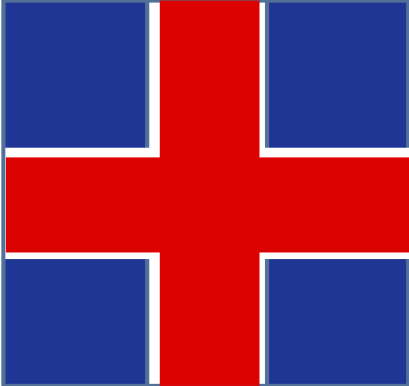
Colonel’s standard

Li-Colonel’s standard
As The Coldstream Guards under Lt-General William Craven, 1st Earl of Craven (1670–1689)
Pikemen (ceased by 1685) and Musketeers: Red coats with green facings (blue by 1685) Bandoleers with a leather collar and N/K strings
Grenadiers: From 1678 – as musketeers but with a cartouche box instead of bandoleers and a red cap turned up blue embroidered in gold. A grenade pouch was worn at the right hip and a plug bayonet and hatchet on the waist belt.
Red breeches and hose up to 1686, then blue breeches and hose.
Waistcoat: probably green, then blue from 1685
Buttons: gold
Scarves: White fringed red (ceased for pikemen by 1677)
Greatcoats (surtouts): Grey with blue or black trimmings
Hats: Black laced about with gold lace and a red hatband and ribbons
Sergeants: Scarlet coats with narrow gold lace to pockets and buttonholes and white (?) scarves.
Standards: Plain white (Col) with crimson St George cross (Lt-Col) and crimson pile wavy in top corner (Major). Captain’s colours differenced for each company with a Roman numeral number in white below the gold crown in the centre.
Cords and tassels; Red with gold tassels (Col and Lt-Col), red for the rest.

Colonel’s standard
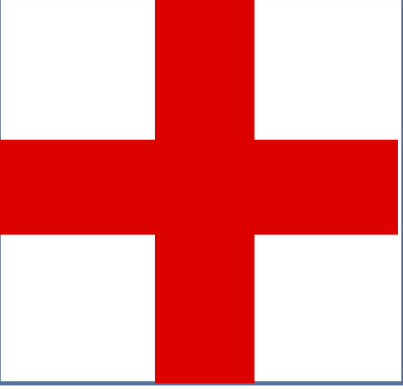
Lt-Colonel’s standard
As The Coldstream Guards (1689-1694)
under Lieutenant-General Thomas Tollemache (1689 – 1694) and Lieutenant-General John Cutts (1st Baron Cutts) (1694-1702).
Musketeers: Red coats with blue facings (with white or yellow trim/lace) Bandoleers with a leather collar covered in blue and N/K strings
Grenadiers: As musketeers but with a cartouche box instead of bandoleers and a red cap turned up blue embroidered in gold. A grenade pouch was worn at the right hip and a plug bayonet and hatchet on the waist belt.
Blue breeches and white hose.
Waistcoat: probably blue
Buttons: gold
All belts covered in blue cloth
Scarves: White fringed red
Greatcoats (surtouts): Grey with blue or black trimmings.
Drummers in red coats with a mass of gold galoon and lace on all seams, edges, buttonholes etc. and a royal cypher embroidered in gold on the breast and back of the coat. Drums were of painted wood with the royal arms on the front.
Hats: Black laced about with gold2 lace and a red hatband and ribbons
Sergeants: Narrow gold lace to pockets and buttonholes and white? scarves.
Standards: White with crimson St George cross and Crown and Cypher (W&M) in centre of cross (Col) with no crown and cypher (Lt-Col) and red pile wavy in top corner (Major). Captain’s colours differenced for each company with a Roman numeral number in white below the gold crown in the centre. Cords and tassels: White and silver tassels and strings.
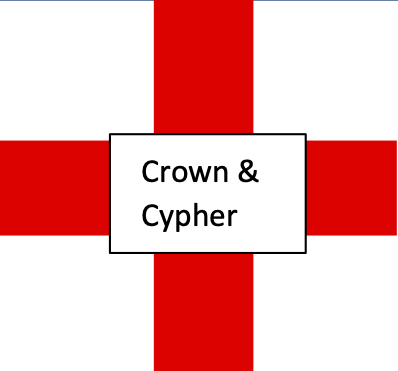
Colonel’s standard
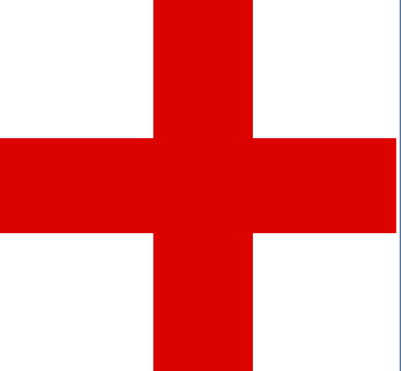
Lt-Colonel’s standard
References
A. Osprey Men-at-Arms The Coldstream Guards
B. The British Army of William III – Alan Sapherson
C. William III at War Scotland and Ireland 1689-1691 – Alan Sapherson
D. The British army of William III 1689-1702 – John Childs
E. The Army of James II 1685-1688 – Stephen Ede-Borrett
E. Wikipedia
NOTE
One of the difficulties of establishing the uniforms of British soldiers in the seventeenth century is that the Government patterns were destroyed by fire in the 18th and 19th centuries. These were samples or complete garments centrally stored in two separate places for setting standards. The data above from the references is sometime in conflict and has been taken from a variety of contemporary sources. It is very unclear at what point the ‘green’ facings of the Coldstream Guards were phased out in favour of the blue used by all the other Household Troops and Guards. This may have been shortly after 1670. They were reported in 1685 as having blue facings and red breeches at the Coronation of James II, but had changed to blue breeches by the muster at Hounslow Heath on 30 June 1686.