The Battle of Walcourt was fought on 25 August 1689 during the Nine Years’ War. The action took place near the ancient walled town of Walcourt near Charleroi in the Spanish Netherlands, and brought to a close a summer of uneventful marching, manoeuvring, and foraging. The battle was a success for the Grand Alliance – the only significant engagement in the theatre during the campaign of 1689.
The Allied army was commanded by the Prince of Waldeck; the French army by the Duc de Humieres. The battle incurred some 2,000 French casualties against the Allied losses of less than 700. The Allied victory had been an auspicious opening of the war for King William III and the Alliance,
Humieres assembled 24 battalions and 75 squadrons, totalling 24,000 men for Louis XIV. Waldeck had about 35,000 men of whom 8,000 were English troops commanded by the Earl of Marlborough. The English troops lacked a proper commissariat and were often short of equipment, clothing and food.
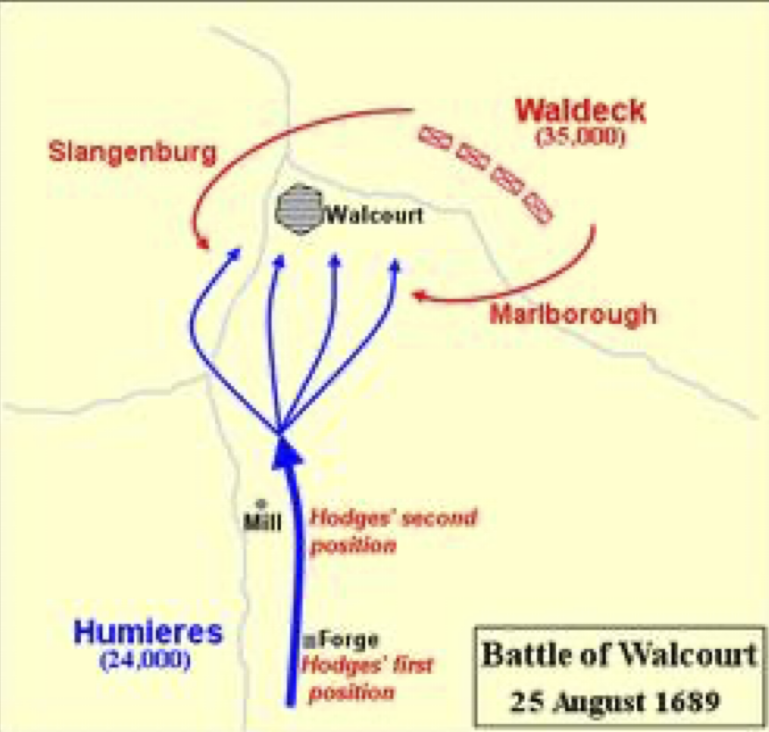 On 25 August, Allied foragers, escorted by 600 English troops of Colonel Hodges’ Regiment (16th Foot, later the Bedfordshire and Hertfordshire Regiment) were sent out to the surrounding countryside. Humières, in an effort to expel the intruders, fell upon the foraging parties and allied outposts about 2 miles (~3 km) south of Walcourt. The foragers were recalled and the Allied camp made readiness for action.
For nearly two hours Hodges’ regiment was able to prevent the development of the French vanguard, and covered the retreat of the surprised foragers before retiring his troops to a nearby mill (see map). By 11:00, Marlborough had arrived within sight of the engagement. Noticing Hodges was under attack by several French batteries, the English commander ordered the embattled colonel to withdraw to a hill east of Walcourt, behind which the main Allied force was forming. Waldeck later commented to William – “[Hodges] and the English, who are with him, have accomplished miracles, and I could never have believed that so many of the English would show such a joie de combattre.”
Despite his troop’s failure to overcome Hodges’ small force, Humières decided to attack Walcourt itself, which had since been occupied by 600 men. The ground was not favourable to the French – although the defences of the town were antiquated, it stood on a hill partly covered by a river. Nevertheless, several attacks were pressed home, but the French suffered heavy casualties from the Allied enfilading guns. Despite the losses Humières persisted, and sent a party of Gardes Françaises to try to set alight Walcourt’s gates. The attempt failed, and the safety of the garrison was assured after Brigadier-General Thomas Tollemache brought the Coldstream Guards and a German Battalion into the town around 14:00.
Humières saw himself forced to widen the battle and now flung his men in an improvised attack against the right wing of the main Allied line beyond the town. However, at about 18:00, Waldeck launched a double counterattack against the tiring French; General Slangenburg’s Dutch against their left, and Aylva with three regiments of foot, supported by Marlborough, at the head of the Dutch Horse Guards and the English Life Guards and Blues, against their right. The French reeled back in disarray but valuable service by the French cavalry, commanded by Colonel Villars, prevented the retreat from becoming a rout, allowing Humières to extricate his men from the field
Extracts from Wikipedia and Marlborough as a Military Commander – Chandler